

Parashat Va’etchanan
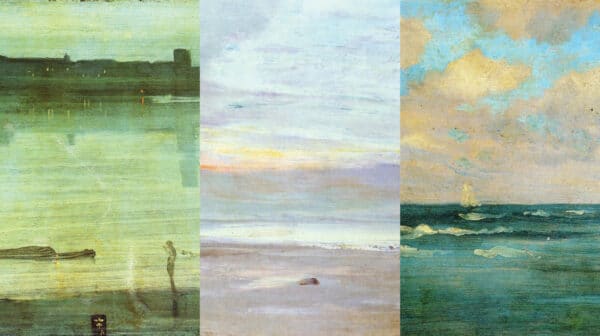
When Blurring the Lines Leads to Clarity and Wholeness
July/August 2026 Window Column by Rabbi David Stern
At the end of July, we will come to Parashat Va’etchanan, the Torah portion which brings us the Sh’ma in Deuteronomy 6:4. It has me thinking of a summer some 20 years ago, when I gained new insight into the Sh’ma thanks to the work of the American painter James McNeill Whistler.
It happened at the Clark Art Institute in Williamstown, Massachusetts, which featured a Whistler exhibition called “Like Breath on Glass.” The title paraphrases an 1880 statement by the artist: “Paint should not be applied thick. It should be like breath on the surface of a pane of glass.” Whether a gloomy twilight on the Thames or the blues and greens of a summer meadow, in these paintings objects gave way to the immaterial, as bold lines become blurred contours, and color creates shape.
Whistler and his followers were criticized by some of their more conventional peers for creating works which lacked sufficient foothold in reality—full of color and suggestion, but lacking shape and story. Whistler and his school painted the feeling of rivers and fields, his critics claimed, but not the reality of the rivers and fields themselves.
But I think we know Whistler and his crew had it just right. When you are on a lake or a hiking trail, you see one level of the woods give way to the next, not with a boundary or a border sign, but with a subtle shift from dark green to silver to the sky’s fading blue. Whistler’s paintings reflected not only a reality of the landscape, but a reality of the human eye and the human heart.
Religious mystics celebrated Whistler’s atmospheric paintings because of the reality they suggest: that our tendency to divide the world into horizontal and vertical lines, do’s and don’ts, city and country, red state and blue state, reflects a need for order that we impose on a much more uid reality. What Whistler and his followers saw and revealed is the reality of the woods by the summer lake—that if we stop long enough to let it, the world around us merges into a oneness that might well be there all along.
And so we come to the Sh’ma. To say that God is one sends numerous messages in our tradition: that God is unique, unitary, one and not many. But “God is one” also suggests that God’s essential unity inheres in the world’s creation—that the hills which merge into the clouds, or the days of tears which merge into laughter, or the anger we sometimes feel towards those we love the most, all reflect the essential unity of creation, and testify that Whistler was wise to blur the lines.
In the first verses of Genesis, God enters creation as ruach Elohim mirachefet al penei hamayim: a wind, a breath from God, that hovers on the waters. Even in a creation story marked by separations, the divine entrance is as a breath on the surface of water, separate and mingled and intangible and profoundly real: like the trees reflected in a summer lake, the whispered goodness in the human soul, the shimmering promise of a new day. Like an ancient prayer of timeless truth: Sh’ma Yisrael, Adonai Eloheinu, Adonai Echad. May we all experience the blessing of oneness in the months ahead.