

Loving Israel Right Now with Aya Margalit
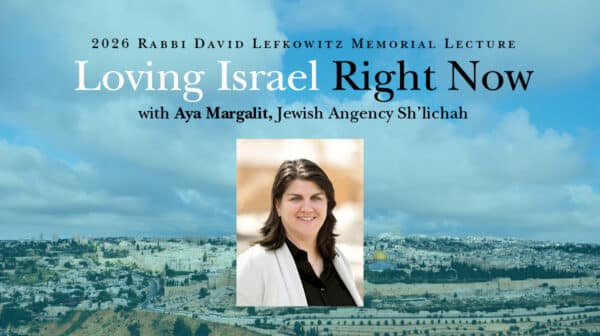
Aya Margalit, our community sh’lichah, or Israel ambassador, will be leading the 2026 Rabbi David Lefkowitz Memorial Lecture for a weekend of learning and reflection on January 9-11. She will share from her heart her journey as a sh’lichah, as well as a deep commitment to helping us imagine what connection to Israel can look like today. Learn more and register for the weekend’s events here.
“I’m going to talk about Israeli society these days,” she explains, “and what’s happening now and how that connects to Jews around the world.”
Redefining Her Voice
Before she arrived in Dallas as Temple’s sh’lichah, Aya says she had a clear sense of what she imagined the role to be. “I want people to have a face, a name, a family that they can think of when they hear about Israel in the news or on social media,” she told The Window in the July/August 2023 edition. “Israel is the most incredible nation of people who care unconditionally. The people truly are what makes the place and I hope to be able to bring a little bit of our love of Israel to Dallas.”
But after October 7, 2023, everything shifted.
“It allowed me to bring a very authentic voice,” she reflects. “It allowed me to bring a very painful and true story…to people who might otherwise experience it at a distance.”
Her presence, along with her family’s, also narrowed the degrees of separation for many congregants. Their faces, their stories and their grief made Israel feel less abstract and more human.
“For me personally, I had to redefine what it means to be a sh’lichah,” she says. “Is my voice going to be only October 7? Because Israel is not and cannot only be October 7. Israel is a land with a 77-year history and a Jewish story thousands of years old.”
Trauma, Aya says, cannot be the defining narrative. “Connections, people, experiences, dreams, hopes, education and collaboration, that’s what needs to be the pillars of our definition of who we are.”
A Weekend of Conversations
Aya will bring the many voices and perspectives of Israel to the congregation, beginning with her Shabbat evening sermon. The Saturday lunch-and-learn will remain intentionally open-ended to invite questions and dialogue. Also joining Aya on Saturday will be Rabbi Nir Barkin, a friend of Temple and Senior Rabbi and Executive Director of Kehillat YOZMA Modi’in of Israel. Rabbi Barkin will also deliver a d’var Torah at the January 10 Shabbat morning service.
During the parent education session on Sunday, Aya hopes to help families navigate how to talk with children about Israel in ways that cultivate trust, understanding and shared values.
“How do you bring the conversation back if it’s stopped?” she asks. “How do you start it if it hasn’t begun?” These are challenges that reflect the wider complexities and tensions many American Jews feel. Still, Aya believes firmly that conversation will solve problems. Silence, she says, will not.
Cultivating a meaningful relationship with Israel, she notes, begins long before a child understands history or politics. “When we read stories to our kids,” she explains, “it’s not just about linguistics. It’s about giving them tools to cope with life.”
Israel, like Judaism, offers children a language of identity, belonging, values and curiosity. “There is so much beauty in Judaism, and so much beauty in Israel as the land of the Jewish people,” she says. “We can give them hope, identity, happiness and the ability to ask questions, to understand that grown-ups make mistakes and that we evolve.”
Curiosity and Hope
Aya hopes the congregation approaches the weekend with curiosity rather than certainty. “I hope people will come with questions, not answers,” she says.
“Judaism has endured because we questioned, challenged and stayed in relationship,” she explains. “Shutting down is simply not who we are.”
She also hopes the weekend brings moments of hope. “Yes, it’s a dark time,” she acknowledges, “but there is a lot of hope seeping in through the cracks, if we are open enough to see it.” She sees that hope daily, in Israelis supporting one another and in the generosity of American Jews. Closer to home, she notes how Temple Emanu-El has supported her in several projects that show love and care for Israel, including Hanukkah gift boxes, participation in the Noya’s Bears project for children, clothing drives and more. “We come together. We lift one another up. We stay together.”
Ultimately, her message is about relationships and responsibility. “To love Israel right now is to love it although it hurts,” she says. What is important is that we stay engaged.
“Keep the conversation going. That’s what matters most.”