

Keeping the Faith — Out of Public Schools
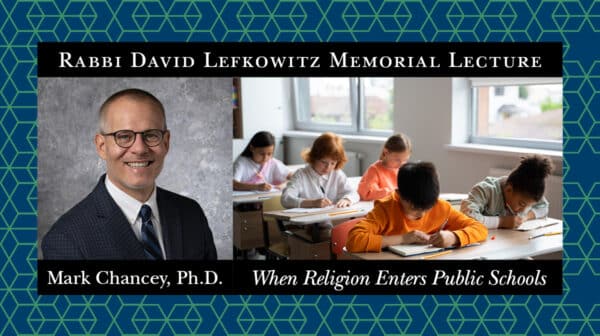
Mark Chancey, Ph.D. returns to Temple for the 2025 Rabbi David Lefkowitz Memorial Lecture on Oct. 24-25 | Learn more and register for the weekend’s events here
Mark Chancey’s connection to Temple Emanu-El began while he was a Ph.D. student at Duke University. One of his mentors, biblical scholar E.P. Sanders, had long before received a grant to study in Israel for a year on the topic of rabbinic Judaism.
Sanders had been a student at Perkins School of Theology and, as it turned out, Temple Emanu-El had been a donor for the trip.
Fast forward to 2005, shortly after Dr. Chancey arrived at SMU’s Department of Religious Studies. A news story from Odessa caught his eye. A Jewish father was protesting the implementation of a Bible elective for high school credit, worried that his daughter would be bullied for being a religious outsider. “It pulled at my heartstrings, and I decided I’d offer to be a resource.” He reached out to the Texas Freedom Network, a progressive advocacy group, and offered to give his take on the curriculum.
“It was jaw-droppingly inappropriate,” he says. “It was a Trojan horse, trying to promote certain forms of Christianity in public schools.” Temple was hosting an event for the Texas Freedom Network and invited Dr. Chancey to speak. That became his first speaking engagement ever on religion and public education. He also was the first speaker for the Katherine F. Baum Lecture Series in 2008.
Now in addition to teaching comparative religion and the New Testament, Dr. Chancey does research in the fields of American religion and church-state studies. His visit to Temple on Oct. 24-25 will particularly focus on two recent high-profile initiatives that challenge the separation of church and state:
• State Board of Education approval of Bluebonnet language arts lessons, which often treat religion in troubling ways, last November
• A new law mandating the display of the Ten Commandments in every public school classroom
“As a scholar and a person of faith, I consider these developments so troubling,” says Dr. Chancey, a Methodist.
“These laws put forward an understanding of the Bible that I don’t share, but even if I did, it still wouldn’t be appropriate for public schools,” Dr. Chancey says. “There are legal ways to study the Bible in public education. What many of our elected leaders are talking about is deeply problematic.”
For example, he says: “One could study the Book of Genesis emphasizing plot, themes, characterization, the same literary aspects one would examine for any piece of literature. Sometimes, however, Genesis is treated as if it’s some sort of science text. It’s one thing to say it’s an important historical source; it’s another thing to say it’s telling a straightforward narrative. Some of Bluebonnet veers into that territory.”
In the case of the Ten Commandments, Dr. Chancey says, few would dispute that they are historically signi cant. “But much of the historical representation is inaccurate and exaggerated. The Declaration of Independence doesn’t quote the Ten Commandments. It’s in the general cultural matrix, but not the de nitive source for everything we’ve built in America.”
Consider the first commandment in the poster that complies with the state law: I am the Lord thy God. “There’s no reference to ‘who brought you out of Egypt.’’’ And in “Remember the Sabbath day, to keep it holy” there’s “no explanation of why Sabbath observance is important, like you find in the Bible. The Jewish elements have been stripped away.”
Dr. Chancey has taken a long and curvy road from his early career studying about the archaeology and history of Galilee as a setting for early Christianity and Judaism. And he is grateful for his circuitous path. “Twenty-one years ago, if you had told me this is what I would be working on, I wouldn’t have believed it. It has been an unexpected but good and productive detour.”
Mark Chancey at Temple
• August 2005: Speaker at a Texas Freedom Network event hosted by Temple
• January 2008: “The New Testament: First-Century Jews, First-Century Christians”Katherine F. Baum Lecture Series
• December 2008: “What’s Right and What’s Wrong: The Bible, Moral Values, and Public Education” Henry D. Schlinger Ethics Symposium
• Spring 2011: “Parallel Pathways: A Jewish-Christian Dialogue” Katherine F. Baum Lecture Series
• October 24-25, 2025: “When Religion Enters the Public Schools” Rabbi David Lefkowitz Memorial Lecture
Orignially published in the 2025 September/October Window