

Beautiful Fusion | Justice Plays a Central Role in Sarah Bassin’s Rabbinate
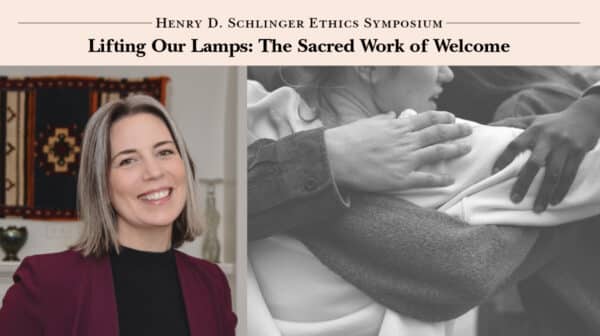
For Rabbi Sarah Bassin, the connection between Judaism and justice was clear long before she became a rabbi.
Growing up, Bassin heard stories about a rabbi in her congregation who challenged a corrupt political machine in the 1930s. It offered her an early vision of what a rabbi could be: someone whose Jewish values shaped their engagement with the wider world.
“I always knew the type of rabbi that I wanted to be would center around justice work,” Bassin said. “It was just this beautiful fusion that I saw of understanding the intersection between my Jewish values and the role that they play in the public sphere.”
That conviction eventually led Bassin to HIAS, the Jewish humanitarian organization that has spent more than 120 years helping refugees and displaced people find safety and rebuild their lives. Today, as HIAS’s Rabbi-in-Residence, Bassin works to mobilize Jewish communities to support immigrants and refugees through direct service, advocacy and partnerships with organizations doing work on the ground.
Rabbi Bassin will bring that work to Temple Emanu-El as the featured speaker for the Henry D. Schlinger Ethics Symposium, October 16-17, exploring immigration through the lens of Jewish values and the enduring responsibility to welcome the stranger.
“We have always had the vision of helping people access welcome and safety and opportunity,” Bassin said. “That vision has never changed, but what it looks like in reality evolves to meet the changing conditions of a world in flux.”
When Jewish communities discuss immigration, one biblical commandment inevitably rises to the surface: love the stranger, for you were strangers in Egypt. Bassin believes there is much more to the Jewish relationship with migration than that familiar phrase.
Migration, she argues, is woven throughout the Torah. Humanity leaves Eden. Babel scatters people across the earth. Abraham and Sarah leave their home and later travel to Egypt because of famine. “There is a centrality of this consciousness of migration that actually informs every aspect of the Jewish story and of Jewish history that marks our collective soul,” Bassin said.
Amid the enormity of global displacement, Bassin finds hope in small acts of welcome. She recalls hearing about a child from a refugee family resettled with help from a synagogue. When another refugee family later arrived nearby, the child, still relatively new to America himself, knocked on their door, accompanied the newly arrived child to the bus stop, and helped him navigate his rst day of school.
Bassin hopes the symposium weekend will offer a sense of possibility and responsibility. Societies can change, she said, sometimes moving further from the values we hold sacred. But they can also change in the other direction.
“We have a role to play,” Bassin said, “in making sure that that’s the direction that it goes.”
Learn more about Rabbi Sarah Bassin’s weekend with us and register for events here.
Originally published in the September/October 2026 edition of The Window